ResearchTrials, meta-analyses
Oatmeal, cooked
Soluble fiber (beta-glucans) is a substrate for butyrate. Cooked into a porridge, never raw or as overnight oats during a flare.
In a flareWith caution
In remissionLean on these
For registered dietitians · IBD clinics · patient organizations
One file that opens in any browser. A food guide that keeps research, clinical practice, and patient lore apart. A meal planner built from what's actually in the kitchen. A lab tracker in U.S. units. No account, no server, nothing leaves the patient's device.

Built by a patient who is also a nurse. I'm Xavier, a French registered nurse, and I've lived with ulcerative colitis for years. I built this for my own flares and remissions first. It has been rewritten for American patients, American labs, and American insurance — and it is licensed to clinicians who want to hand their patients something better than a photocopied food list.
Three levels of evidence, never merged
Oatmeal, cooked
Soluble fiber (beta-glucans) is a substrate for butyrate. Cooked into a porridge, never raw or as overnight oats during a flare.
Coffee
No data shows it worsens inflammation. But it triggers the gastrocolic reflex within 5 to 30 minutes: with an ulcerated colon, that means urgency and extra bowel movements. A comfort problem, not a disease problem.
Fermented foods
Open contradiction: microbiome benefits are described on one side, histamine problems on the other. Avoid during a flare, test in remission.
Three entries from the guide, shown as the patient sees them. The level is always on the card, so nobody has to guess which kind of knowledge they are acting on. How the levels are assigned
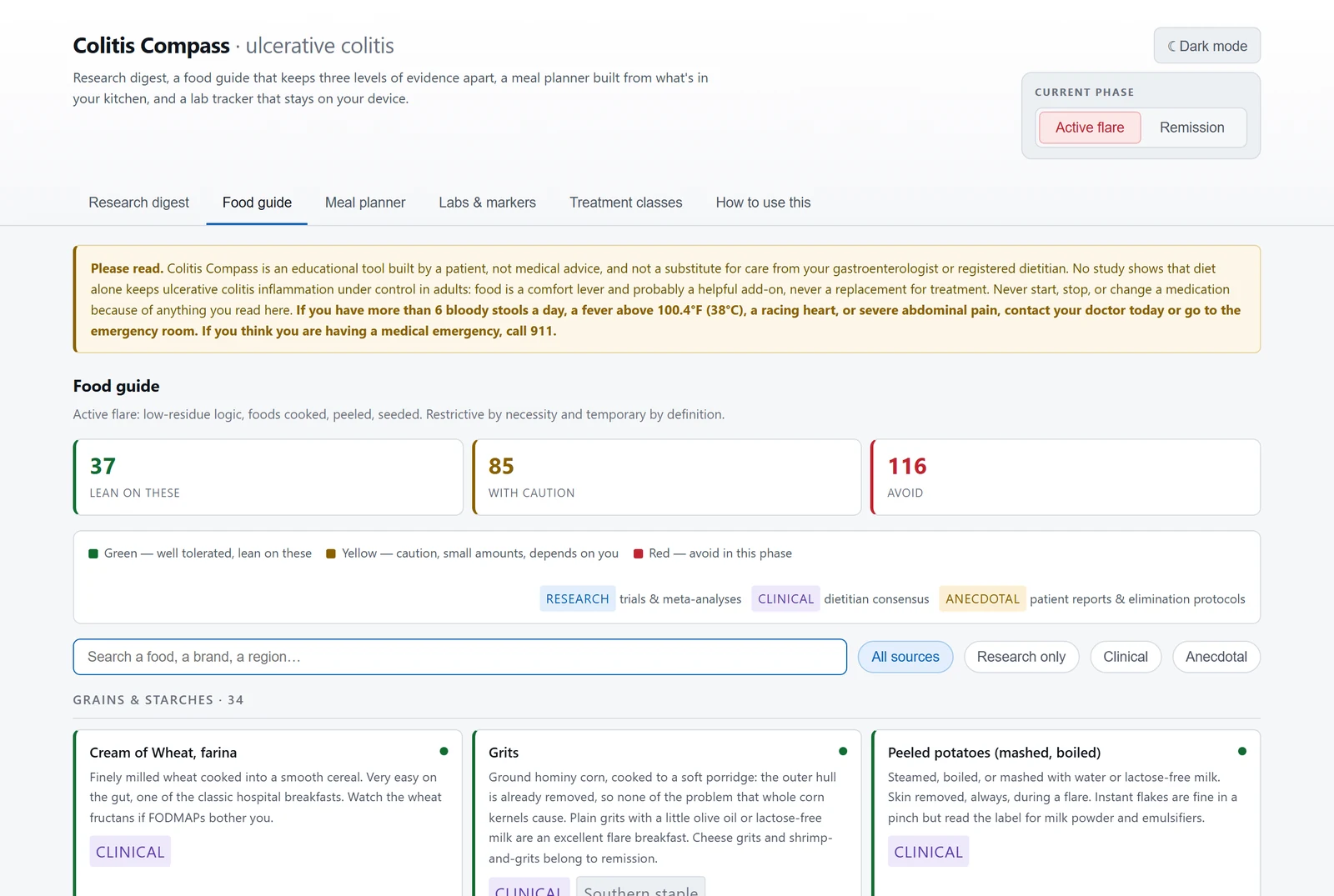
238 foods, each rated for a flare and for remission, each carrying its level of evidence.
What's inside
Food guide
Written for the American table: grits, bagels, corn tortillas, sweet tea, Gatorade, ranch, rotisserie chicken, coffee creamer. Every rating shows its level of evidence — research, clinical, or anecdotal — and the three are never merged. Regional tags, because the U.S. does not eat one way.
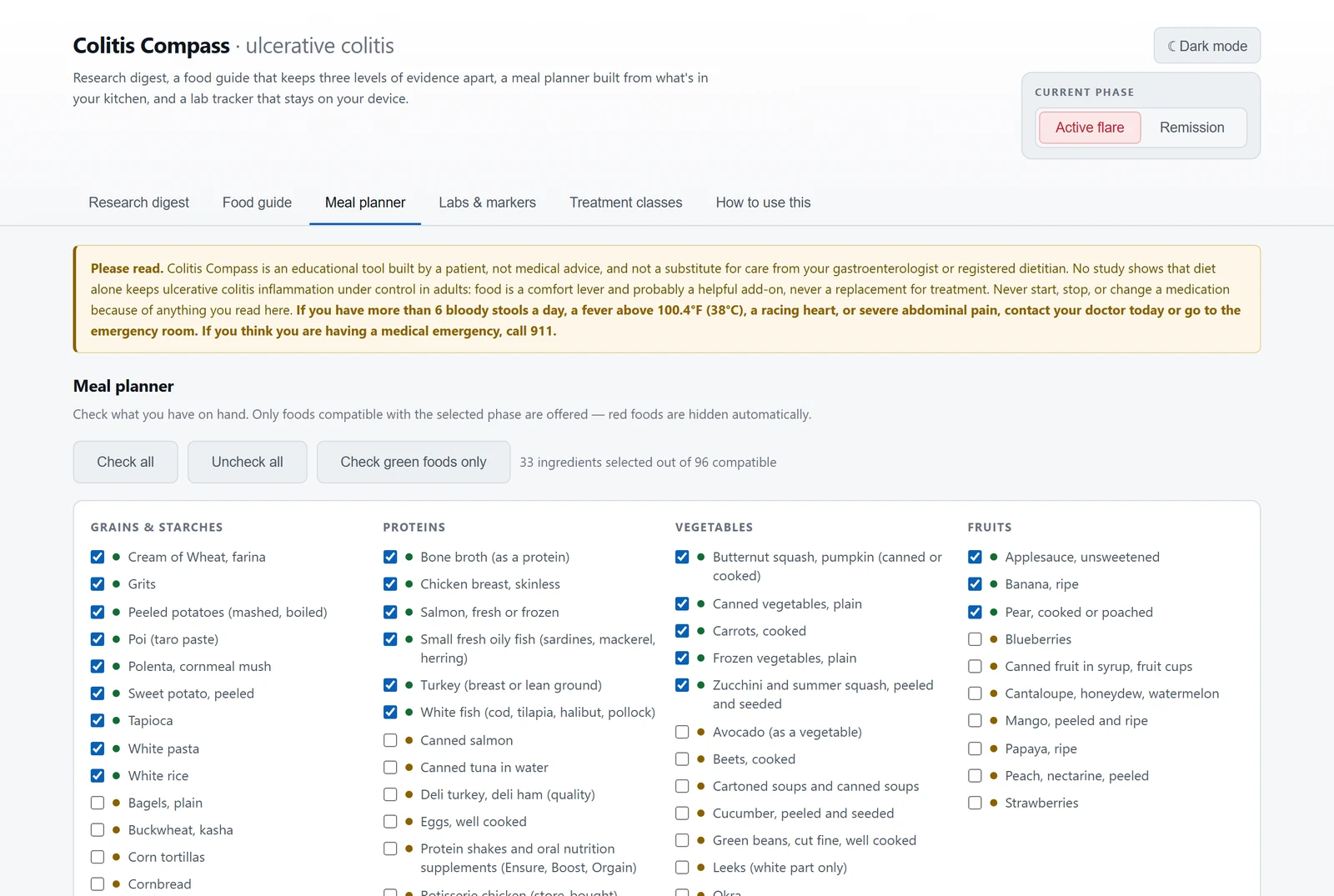
Meal planner
The patient checks what they have. The tool builds a week of meals compatible with the current phase, hides red foods, and says what is missing instead of inventing.
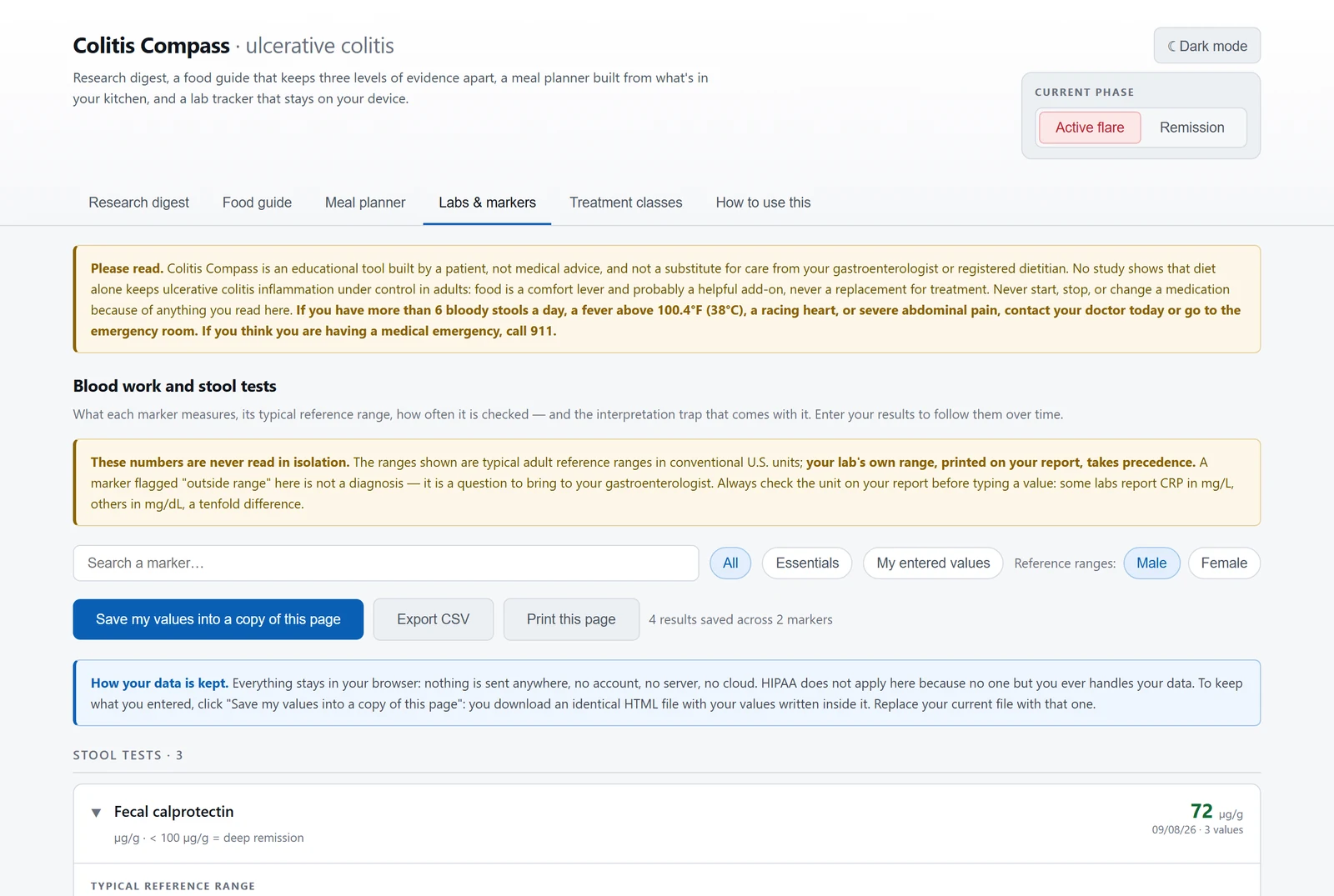
Labs & markers
Typical reference range, how often it's checked, what it measures, why it matters in UC, and the interpretation trap. Entry, trend lines, CSV export, male/female ranges. A CRP unit selector, because U.S. labs report it in mg/L or mg/dL.
Treatment classes
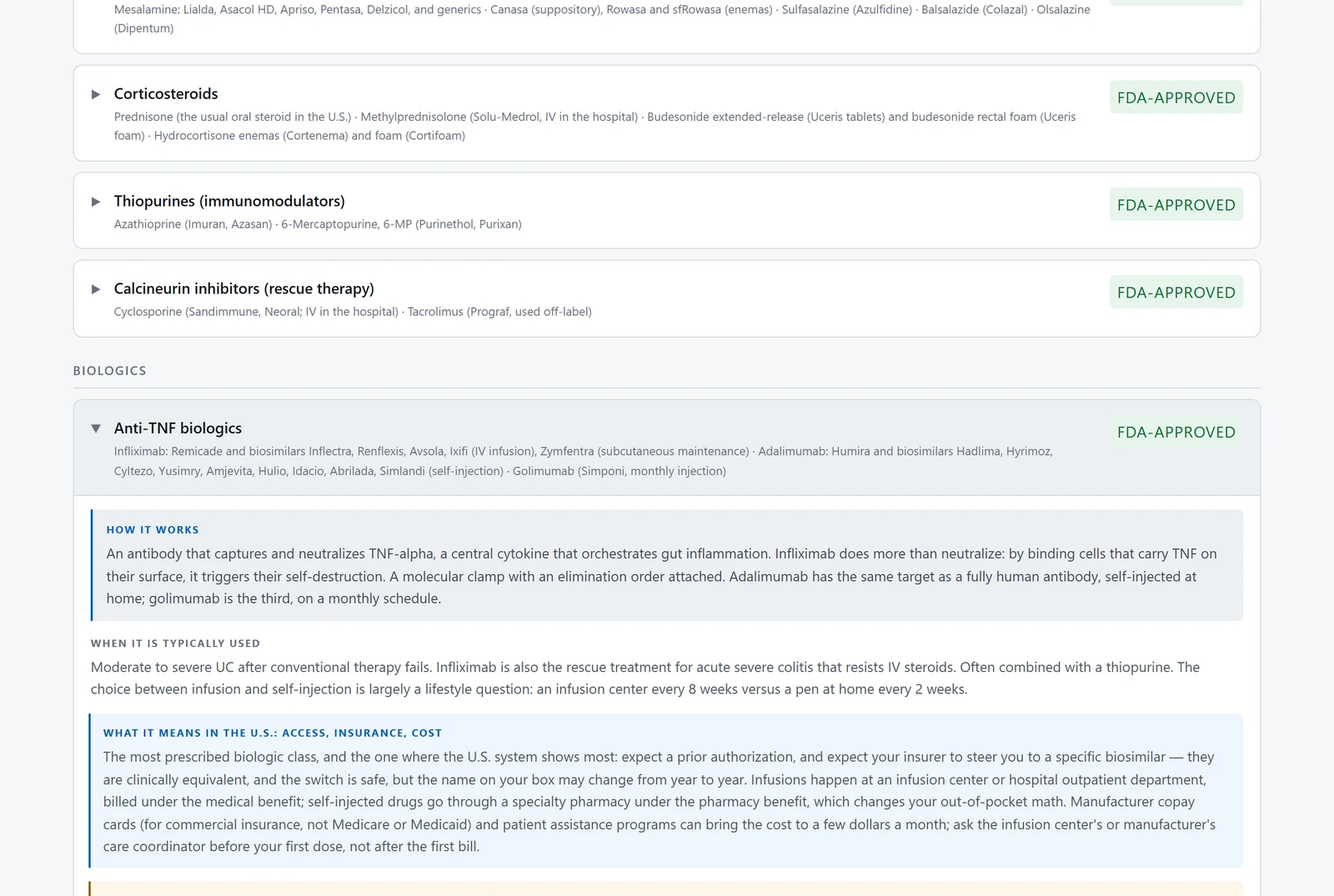
From 5-ASAs to investigational drugs: how the class works, when it's typically used, what it means for prior authorization, step therapy and biosimilar switching, and what gets monitored.
Research digest
PubMed-indexed journals and trial results, each with a "what it changes" paragraph, automatic archiving after two years, favorites saved in the file.
How to use this
How to read the evidence levels, how to test a food on yourself one variable at a time, the warning signs that mean "call today," and the complete terms of use.
Why it's different
Most UC apps ask for an account, send data to a server, and blur the line between a trial and a forum post. This does the opposite on all three counts.
Pricing
Professional license
Ask for the demo: food guide, meal planner, labs, and ground rules complete; research digest and treatment classes shortened. Run it on your own computer, show it to a patient, judge for yourself.
[email protected] · Two-page offer (PDF) · License agreement
Patient organizations and structured nutrition programs can have the "anecdotal" level carry their program's name, by written agreement, as long as the other two levels and the warnings stay untouched. Write to discuss.
FAQ
No. Colitis Compass is an educational and organizational tool. It is not medical advice, not a medical device, and has not been evaluated by the FDA. It does not diagnose, treat, or prescribe. Every card points the patient back to their gastroenterologist, and clinicians remain responsible for the advice they give.
By clicking "Save my values into a copy of this page." The browser downloads an identical HTML file with their values written inside it. They replace the old file with the new one. No account, no sync, no cloud: the file is the database.
The tool never transmits or stores anything outside the patient's device, and its author never receives any data. There is no covered entity or business associate relationship to create. If you keep copies containing patient information in your practice, you handle them like any other patient record.
Yes. It's a single HTML file: it opens in Safari, Chrome, Edge, or Firefox on any device, works offline, and prints cleanly. Dark and light themes.
The license covers the delivered version, with no update obligation. The research digest has a monthly update pipeline and new versions may be offered separately; license holders hear about them first. Corrections reported by clinicians go into the next version.
As a digital file delivered immediately, the license is non-refundable except if the file cannot be opened in a current major browser and that cannot be fixed within 14 days. That is why the demo exists: try it first.
Xavier Pingenot, a French state-registered nurse living with ulcerative colitis, who built the tool for himself before licensing it. Every research entry links to its source. Every food rating shows its evidence level. Every clinical statement is written to be checked by a professional, and the author asks clinicians to report what they find wrong — that feedback is the product's main quality process. Read his full background